2023
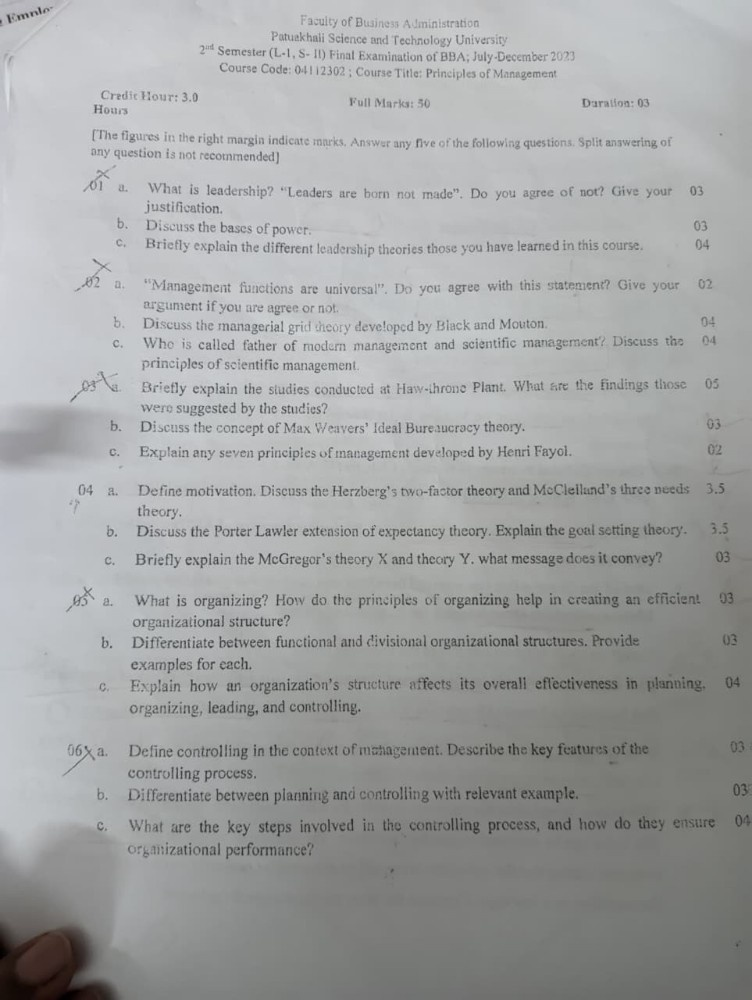
Question 1
1. a) What is leadership? "Leaders are born not made". Do you agree or not? Give your justification. (03 Marks)
-
Leadership: Leadership is the process of influencing, motivating, and directing individuals or groups toward the willing achievement of organizational goals.
-
Born vs. Made Justification: I do not fully agree with the statement "Leaders are born, not made." While early Trait Theory suggested individuals inherit innate qualities like charisma, intelligence, and extraversion, modern management demonstrates that leadership comprises acquirable competencies. Effective leadership depends on strategic thinking, decision-making, emotional intelligence, and interpersonal communication—skills that are learned, developed, and refined through education, training, mentorship, and practical experience.
1. b) Discuss the bases of power. (03 Marks)
According to French and Raven, managers derive influence from five distinct bases of power:
-
Legitimate Power: Power derived from an individual's formal structural position or rank within an organizational hierarchy.
-
Reward Power: Power stemming from the ability to allocate valued rewards, praise, bonuses, or promotions to subordinates.
-
Coercive Power: Power based on the authority to impose sanctions, disciplinary actions, demotions, or penalties.
-
Expert Power: Influence derived from possessing specialized knowledge, technical skills, or unique expertise.
-
Referent Power: Influence based on personal charisma, respect, admiration, and interpersonal identification.
1. c) Briefly explain the different leadership theories those you have learned in this course. (04 Marks)
-
Trait Theory: Proposes that leadership capacity is inherent, focusing on identifying stable personal qualities (e.g., integrity, intelligence, self-confidence) that distinguish leaders from non-leaders.
-
Behavioral Theories: Focuses on specific behaviors executed by leaders rather than personal traits. Includes classic leadership styles (Autocratic, Democratic, Laissez-Faire) and Blake & Mouton's Managerial Grid.
-
Contingency / Situational Theories: Asserts that no single leadership style is universally effective. Optimal leadership depends on matching the leader's style to situational variables, follower maturity, and environmental dynamics (e.g., Fiedler's Contingency Model, Hersey-Blanchard Situational Theory).
-
Transformational vs. Transactional Theories:
-
Transactional Leadership: Relies on routine exchanges, clear structures, and contingent rewards/penalties to maintain operational standards.
-
Transformational Leadership: Inspires followers through a shared vision, intellectual stimulation, and individual encouragement to exceed baseline performance.
-
Question 2
2. a) "Management functions are universal". Do you agree with this statement? Give your argument if you are agree or not. (02 Marks)
Yes, I agree. Management functions (Planning, Organizing, Leading, and Controlling) are universal because they are required in every structured human endeavor regardless of the organization's type (commercial, non-profit, government, educational), size, or geographical location. While operational methods vary, the underlying process of allocating resources to achieve objectives remains constant across all institutional levels.
2. b) Discuss the managerial grid theory developed by Blake and Mouton. (04 Marks)
Blake and Mouton’s Managerial Grid measures leadership styles across two behavioral dimensions on a 9 x 9 matrix: Concern for Production (X-axis, 1–9) and Concern for People (Y-axis, 1–9).
Concern for People (Y-Axis)
  9 | (1,9) Country Club      (9,9) Team Management
    |
  5 |         (5,5) Middle-of-the-Road
    |
  1 | (1,1) Impoverished      (9,1) Task Management
    +----------------------------------------------
      1                       5                 9
                Concern for Production (X-Axis)
-
Impoverished Management (1,1): Minimum concern for both production and people, resulting in operational failure and poor employee morale.
-
Task / Authority-Compliance Management (9,1): High focus on operational output with low concern for human needs; relies on strict command and control.
-
Country Club Management (1,9): High concern for employee relationships and comfort at the expense of production performance.
-
Middle-of-the-Road Management (5,5): Moderate compromise balancing work output with employee morale.
-
Team Management (9,9): The optimal leadership style; high concern for both production and people creates motivated, high-performing teams committed to shared goals.
2. c) Who is called father of modern management and scientific management? Discuss the principles of scientific management. (04 Marks)
-
Father of Modern Administrative Management: Henri Fayol.
-
Father of Scientific Management: Frederick Winslow Taylor (F. W. Taylor).
Principles of Scientific Management (F. W. Taylor):
-
Science, Not Rule of Thumb: Replace subjective habits, guesswork, and traditional methods with scientifically derived job standards developed through time-and-motion studies.
-
Harmony, Not Discord: Establish mutual understanding and alignment between management and labor through a mental revolution and profit sharing.
-
Cooperation, Not Individualism: Encourage active collaboration between workers and managers to ensure work is carried out according to scientific standards.
-
Development of Each Person to Their Greatest Efficiency: Scientifically select, train, and develop employees to match their personal skills with optimal job tasks.
Question 3
3. a) Briefly explain the studies conducted at Hawthorne Plant. What are the findings those were suggested by the studies? (05 Marks)
The Hawthorne Studies were conducted by Elton Mayo and Fritz Roethlisberger between 1924 and 1932 at Western Electric’s Hawthorne Works.
-
Key Experimental Phases:
-
Illumination Experiments: Evaluated productivity under changing light levels; output increased in both experimental and control groups regardless of light intensity.
-
Relay Assembly Test Room Experiments: Tested physical working conditions (rest periods, work hours, incentive plans); productivity steadily increased due to group solidarity and positive supervisor attention.
-
Bank Wiring Observation Room: Analyzed informal social groups and found that workers enforced informal output caps to protect group security.
-
-
Major Findings:
-
The Hawthorne Effect: Workers alter and improve their productivity when they realize they are receiving special attention and observation from management.
-
Social & Psychological Factors: Social recognition, feeling valued, and group morale drive worker motivation more than physical working conditions or financial incentives.
-
Informal Group Norms: Work groups form informal social systems that strongly dictate individual performance standards and daily output limits.
-
3. b) Discuss the concept of Max Weber's Ideal Bureaucracy theory. (03 Marks)
Max Weber proposed Bureaucracy as a rational, highly structured organizational framework designed for maximum efficiency, predictability, and fairness.
-
Key Characteristics:
-
Division of Labor: Tasks are clearly divided into specialized roles.
-
Hierarchy of Authority: A clear scalar chain where each administrative level is supervised by a higher authority.
-
Formal Rules and Regulations: Explicit written guidelines standardize operational decisions.
-
Impersonality: Rules and performance reviews are enforced uniformly without favoritism or personal bias.
-
Merit-Based Selection: Employment and promotions are based strictly on technical qualifications and objective performance metrics.
-
3. c) Explain any seven principles of management developed by Henri Fayol. (02 Marks)
-
Division of Work: Specialization increases efficiency and total output.
-
Authority and Responsibility: Managers must have the authority to give orders, balanced by accountability for outcomes.
-
Discipline: Workers must respect organizational rules and agreements.
-
Unity of Command: Subordinates should receive instructions from only one direct supervisor.
-
Unity of Direction: All operations with the same objective must be directed by one manager using one unified plan.
-
Subordination of Individual Interest: Organizational goals take precedence over personal interests.
-
Scalar Chain: A clear, unbroken line of authority runs from top executive management down to frontline staff.
Question 4
4. a) Define motivation. Discuss the Herzberg's two-factor theory and McClelland's three needs theory. (3.5 Marks)
-
Motivation: Motivation represents the internal and external forces that initiate, direct, and sustain goal-oriented human behavior.
-
Herzberg's Two-Factor Theory:
-
Hygiene Factors (Extrinsic): Working conditions, salary, supervision, and company policies. Removing hygiene deficiencies eliminates dissatisfaction but does not actively motivate.
-
Motivators (Intrinsic): Achievement, recognition, responsibility, and personal growth. These directly drive high satisfaction and internal motivation.
-
-
McClelland's Three Needs Theory:
-
Need for Achievement (nAch): Drive to excel, hit targets, and solve complex problems independently.
-
Need for Power (nPow): Drive to influence, control, lead, and direct others.
-
Need for Affiliation (nAff): Drive for warm, harmonious interpersonal relationships and social acceptance.
-
4. b) Discuss the Porter Lawler extension of expectancy theory. Explain the goal setting theory. (3.5 Marks)
- Porter-Lawler Extension of Expectancy Theory: An expanded motivation model building on Victor Vroom's theory. It asserts that effort does not automatically lead to performance. Performance depends on two intervening variables: Abilities/Traits and Role Perceptions. Performance then yields intrinsic and extrinsic rewards, which produce overall satisfaction when perceived as fair and equitable.
[ Effort ] ---> [ Ability & Role Perception ] ---> [ Performance ] ---> [ Intrinsic & Extrinsic Rewards ] ---> [ Perceived Equity ] ---> [ Satisfaction ]
- Goal Setting Theory (Edwin Locke): States that specific, challenging goals lead to higher task performance than vague or easy goals (e.g., "do your best"). Key factors driving goal achievement include goal commitment, regular performance feedback, task self-efficacy, and clear targets.
4. c) Briefly explain the McGregor's theory X and theory Y. What message does it convey? (03 Marks)
-
Theory X Assumptions: Assumes employees intrinsically dislike work, lack ambition, avoid responsibility, and must be strictly controlled, monitored, and coerced to achieve targets.
-
Theory Y Assumptions: Assumes employees view physical and mental work as natural, seek responsibility, are self-directed, and possess inherent problem-solving creativity.
-
Message Conveyed: A manager's fundamental assumptions about human nature create self-fulfilling prophecies. Adopting a Theory Y mindset encourages trust, employee empowerment, and higher organizational performance.
Question 5
5. a) What is organizing? How do the principles of organizing help in creating an efficient organizational structure? (03 Marks)
-
Organizing: The management function of arranging human, physical, and financial resources and establishing structured authority relationships to achieve organizational objectives.
-
Contribution of Principles to Structure:
-
Division of Labor: Ensures tasks are assigned based on specialization, boosting efficiency.
-
Unity of Command & Scalar Chain: Eliminates authority conflicts and provides unambiguous reporting lines.
-
Span of Control: Optimizes supervisor-to-subordinate ratios for effective oversight.
-
Delegation of Authority: Empowers operational levels while maintaining central strategic control.
-
5. b) Differentiate between functional and divisional organizational structures. Provide examples for each. (03 Marks)
| Parameter | Functional Structure | Divisional Structure |
|---|---|---|
| Grouping Basis | Grouped by specialized occupational functions (e.g., Finance, HR, Marketing). | Grouped by products, services, geographic regions, or target markets. |
| Autonomy | Centralized decision-making controlled by top executives. | Decentralized; each division operates as a semi-autonomous profit center. |
| Operational Focus | Emphasizes operational efficiency and functional expertise. | Emphasizes market adaptability and product responsiveness. |
| Example | A manufacturing company structured into Accounting, Production, and Sales departments. | A conglomerate structured into Electronics Division, Healthcare Division, and Automotive Division. |
5. c) Explain how an organization's structure affects its overall effectiveness in planning, organizing, leading, and controlling. (04 Marks)
-
Effect on Planning: Flat/organic structures allow fast information flow and agile strategic planning, while tall bureaucratic hierarchies can slow decision-making due to multi-layered approvals.
-
Effect on Organizing: Directly establishes job boundaries, departmental divisions, and resource allocation workflows.
-
Effect on Leading: Determines leadership communication channels, spans of supervision, and the degree of employee empowerment versus strict supervision.
-
Effect on Controlling: Provides clear lines of accountability and reporting pathways, enabling accurate performance tracking and timely corrective action.
Question 6
6. a) Define controlling in the context of management. Describe the key features of the controlling process. (03 Marks)
-
Controlling Definition: The process of monitoring performance, comparing actual results against pre-established standards, identifying deviations, and taking corrective action to align operations with plans.
-
Key Features:
-
Continuous & Dynamic: An ongoing management loop rather than a one-time event.
-
Goal-Oriented: Evaluates performance strictly against planned objectives.
-
Pervasive: Required across all operational levels and functional departments.
-
Forward-Looking: Uses variance analysis to prevent operational failures in future cycles.
-
6. b) Differentiate between planning and controlling with relevant example. (03 Marks)
-
Planning: A forward-looking function that establishes future objectives, strategies, and operational benchmarks.
-
Controlling: A backward-looking function that measures executed work against standards to evaluate success.
-
Example: A smartphone manufacturer sets a target to produce 10,000 units per week (Planning). At the end of the week, management measures actual output at 8,500 units, identifies a component supply delay, and adjusts assembly line scheduling (Controlling).
6. c) What are the key steps involved in the controlling process, and how do they ensure organizational performance? (04 Marks)
[ 1. Establish Standards ] ---> [ 2. Measure Performance ] ---> [ 3. Compare Against Standards ] ---> [ 4. Take Corrective Action ]
-
Establishing Performance Standards: Sets clear, measurable benchmarks (e.g., sales targets, quality levels, cost limits).
-
Measuring Actual Performance: Gathers operational data accurately through reports, audits, and performance tracking systems.
-
Comparing Performance Against Standards: Analyzes the variance between actual results and targets to identify performance gaps (
). -
Taking Corrective Action: Addresses root causes of underperformance (e.g., retraining staff, repairing equipment) or adjusts targets, guaranteeing continuous performance alignment.